🔥 A Tender Apocalypse – If God Walked Among Us
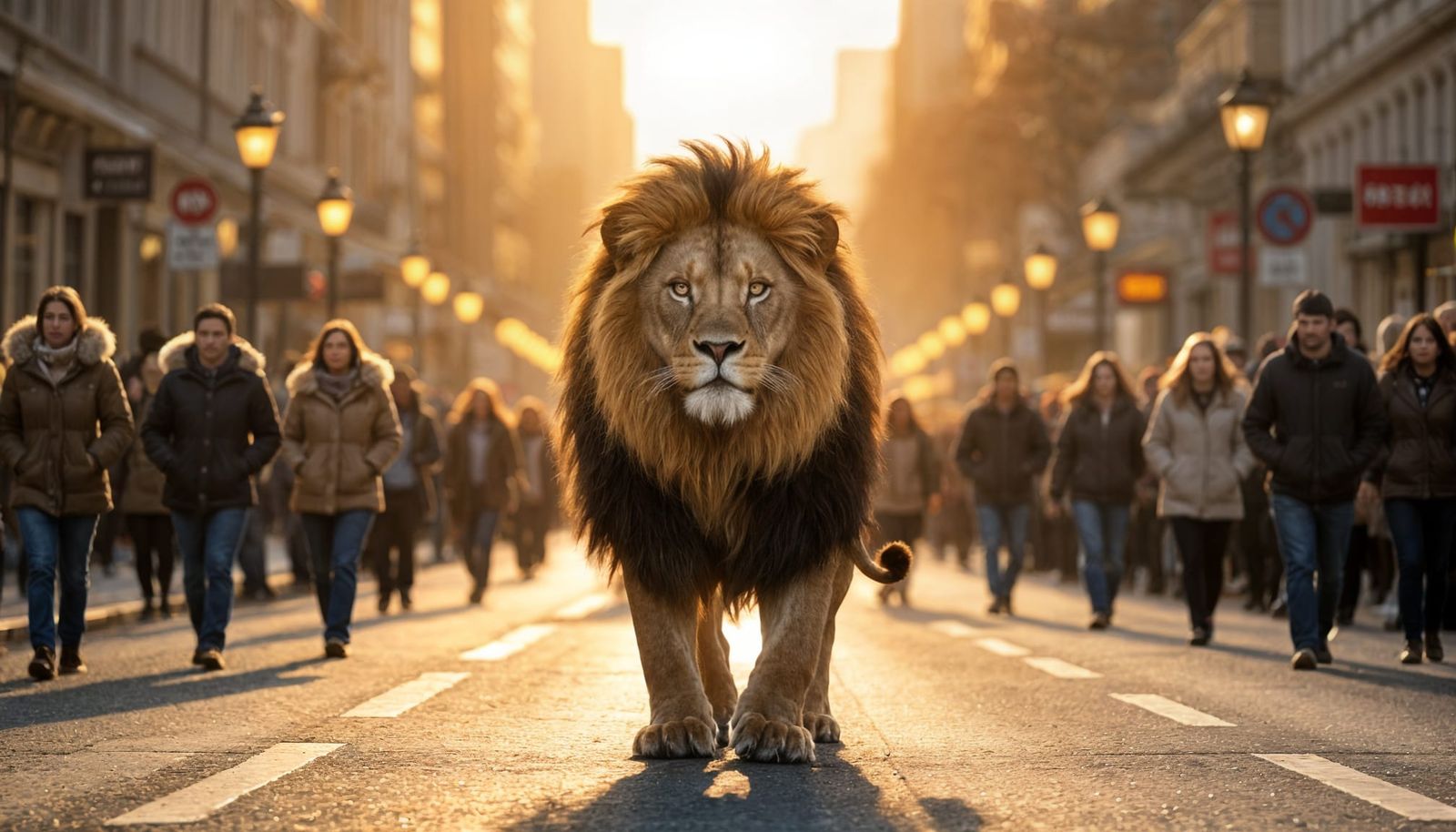
Imagine, for a moment, that the Divine learns to dress down. Not in robes of unquestionable glory, but in smudged jeans and a thrift-store jacket — hands that remember both labour and mistakes. Imagine this being choosing, deliberately, to appear unremarkable. No thunderclaps. No light shows. Just a quiet body that hurts, laughs, forgets deadlines, pays bills late, gets enraged and tender in the same afternoon...
Would you believe?
We expect the Sacred to arrive as the specta-perfectular – clean, flawless, superior. We confuse perfection with proof. We measure divinity by superpowers, as if holiness required spectacle... or perfection. But what if incarnation was never meant to confirm our ideas of perfection — but to dissolve them?
What if the Divine wanted to show us our divinity not through perfection, but through fallibility — by becoming recognizable rather than untouchable?
Because how could we ever recognize our own sacredness if it only ever appeared as something flawless, distant, and fundamentally unlike us?
If a perfect, faultless being stood before us and said, “I am like you,” we might admire it — but we would hardly see ourselves in it. We would remain observers, not participants.
And perhaps recognition can only happen where difference dissolves just enough for reflection to become possible — where the Sacred is close enough to be human, and the human is revealed as already sacred.
🚎 Just a Slob Like One of Us
So if God stood next to you at a bus stop and fumbled with exact change, would that be less true than a voice from a cloud? Or would it be more persuasive — because it shows that being human and being sacred are not opposites but overlapping circles of the same truth?
To see divinity in an ordinary, imperfect life is to be invited to see it in your own. And the disbelief that God could stand beside you, ordinary and awkward, is really a disbelief in your own worth.
If you reject an unvarnished, vulnerable Divine, do you not quietly say that holiness must look like superiority? That worthiness must be visible?
The deeper unbelief is not about God; it’s about whether you will allow your own human mess to be a vessel for the Sacred.
Because such a being would not come to demand worship, but to invite loyalty to yourself. Their presence would not ask you to kneel, but to stand. To believe in your own divinity, your own equal worth, your unshakable place in existence.
The highest honour would not be kneeling before them — it would be standing fully as yourself. 🥹
An undercover God
Imagine an undercover God — present in the supermarket queue, the call centre, the backroom staff meeting. Not as a test, not as a trick, but as a radical experiment in authenticity.
A visible God would not simply unite humanity through appearance. If revealed all at once, it would likely destabilize more than it harmonizes. Some would worship. Some would perform: displays of piety, humble brags, ritualized kindness. Many would audition for God’s favour instead of being themselves.
Others would try to use it. Still others would fear it. And some would try to destroy it. Not because it is dangerous — but because it cannot be controlled, predicted, categorized, or made to fit our expectations.
But what if this presence did reveal itself gradually? Not constantly. Not to everyone. But in moments. In glimpses. In cracks where something in us is ready. Then unity is not imposed from above. It emerges from recognition: humanity seeing itself reflected in the Divine, and in that reflection, in each other.
So perhaps the Divine does not remain hidden out of distance —
but out of compassion and precision: Creating a space where true selves might appear, unstage-managed. Revealing itself only where it can be met without distortion. Where it does not become spectacle, but recognition.
😵💫 We Close Our Eyes By Thinking We See
We love to script the Divine. We think we know how God should and would sound, act, intervene. That certainty — the “I already know” — is often what closes perception. When the Sacred appears ambiguous, we rush to define, to explain, to control. We want proofs because proofs are safer than transformation.
Transformation was never meant to be a single lightning strike but a slow unfolding — whispers, gestures, tiny openings of heart. Maybe the Divine prefers patience over spectacle, trusting that small revelations endure where revolutions fade.
And perhaps this is what ancient wisdom has been whispering all along —
not loudly, not as doctrine, but as something you recognize the moment you stop trying to become and simply are.
Yahweh & Soham
Yahweh. A name — and not a name. A pointing.
The sound of breath, returning to itself.
Rooted in Ehyeh Asher Ehyeh — “I am who I am.” (simply being, timeless) or “I will be who I will be” (developing oneself, time makes it possible).
Not fixed. Not captured. A living beingness. Unfolding. Self-existing. Untamed. And maybe this was never meant as something you look at and say: “He is.” Maybe it was an invitation. Not to point outward — but to recognize: I am, too.
And then — from another tongue, another land — Soham: “I am that.” Not separate. Not outside. Not asking for permission to belong. The same breath, turning in a different direction.
You don’t have to disappear to be whole. You don’t have to become something else to be real. You are fully yourself — and not separate from the whole. Not a role. Not a mask. Not a performance. Only presence.
Holiness was never about becoming worthy. And divinity was never somewhere else. It is here — unpolished, unmistakable, alive — the moment you stop pretending to be anything but yourself.
🌈 A Tender Apocalypse
This thought experiment is not about politics or prophecy — it’s about an inner economy: the cost of forgetting your own divinity.
If God showed up as ordinary and you still refused to believe, the loss would be yours – a deeper unbelief in your own sacred potential.
If many believed, what an undoing that would be: systems of shame and scarcity would shake; presence would matter more than product, relationship more than ROI.
The true scandal of an imperfect God is not the absence of miracles, but the demand for participation. Their miracle would be to reveal that holiness is messy, touchable, available — not a prize for purity, but the baseline of being.
To recognize them is to recognize yourself.
🌱 A Gentle Experiment
Perhaps, for just one moment, try this:
When you step into the world, imagine that the first being you truly meet — whether a stranger, a friend, an animal, a tree, or any living expression of existence — is the Divine meeting you in a form you did not expect.
Not as an idea. Not as a performance. Just as a quiet invitation:
“Can you recognize me here?”
Because how could we recognize a presence we have not yet opened ourselves to receive? Sometimes it is not that the song is missing... Sometimes the radio is simply not tuned to the frequency where the music is already playing.
So maybe the Sacred has never been far away.
It has simply been waiting for the moment when we become quiet enough to listen.
In that moment, something within us softens.
And perhaps one moment
becomes another...
And another.
Until the way we see begins
to change the way we live.
Belief, then, is not about bowing – it is about remembering...
...that to be flawed is not to be less divine; it is to be the exact container for compassion, courage, and the small rebellions that change the world: a spoken apology, an unpaid lunch, a table turned over when greed sits at it.
If God came wearing human skin, borrowed clothes, and whispered, “I am like you”, would you hear the invitation to see your own divinity, your worth, your power, your true greatness?
Would you join the slow, tender revolution of seeing and being seen? Or would you demand proof so loud that you miss the quiet proof standing beside you — and the one looking back at you from the mirror?
Perhaps apocalypse has never been the destruction of an old world.
Perhaps it has always been an unveiling.
Not the end of the world...
But the end of everything that kept us from recognizing it.
A tender awakening.
Remember.
Wake up.
Look in the mirror.
Look next to you.
In this very moment
the Sacred might be
tripping over its shoelaces
— and that is exactly the point. 🕊️✨
❤️💛💚
Yours and mine,
I & I 🦁


Comments
Post a Comment