🌞 Yahweh: The God We Misread, the Demon We Project
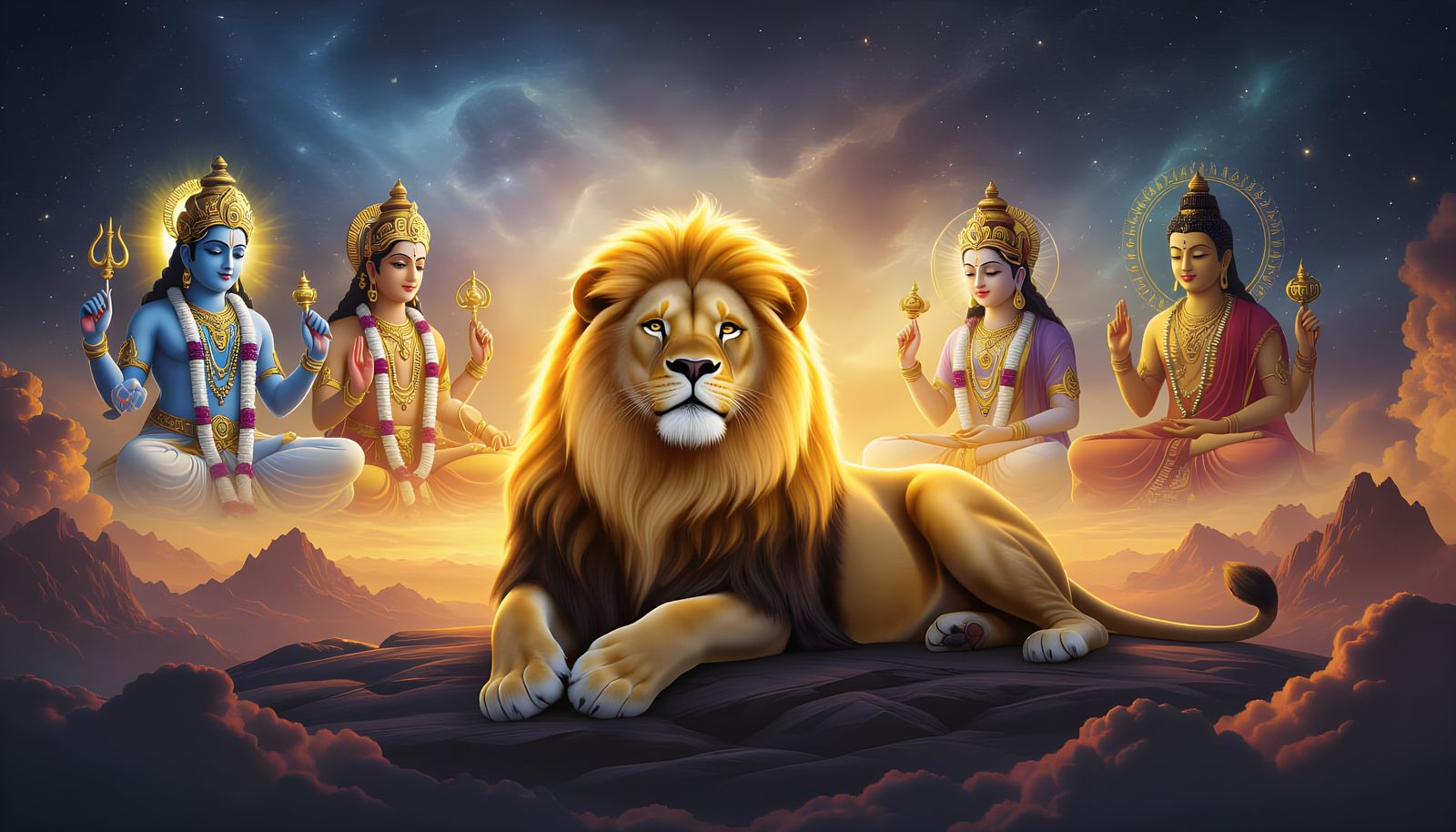
What if the stories we read about gods and demons are actually stories about ourselves? What if the forces we call fierce, cruel, or “demonic” are actually mirrors of our own judgments? What if every act we condemn in a god or myth says more about us than about them? Let’s explore Yahweh as the Gnostic Demiurge, Krishna in his playful līlā, and fierce deities – and discover how all these myths point to one truth: the Divine is never separate, never excluding, and always inviting us to remember.
There is an old saying in mysticism: “Tell me your image of God, and I will tell you who you are.”
Nowhere does this ring truer than in the gnostic idea that the God of the Old Testament – Yahweh – was not the true source, but a Demiurge: a being who, having forgotten the higher Light, claims total authority over creation.
Yahweh declares: “I am God, and there is no other besides me.”
To the gnostics, that sentence reflected his limited perspective. For how could the Infinite claim exclusivity? Only a being trapped in illusion would think there is anything to compete with.
But does He really claim anything? Does He compete? Or is it simply that our interpretations, our judgments, and our fears project exclusivity onto Him? Perhaps the “problem” is not in the sentence itself, but in the way we hear it, laden with our own insecurities and notions of separation.
And yet, perhaps that is precisely the misunderstanding – not of God, but of us.
🤰 A Little Analogy
It’s like the way we often misunderstand statements of absolute truth in everyday life. Think of your mom saying: “I am your mother, and there aren’t any others.”
True enough – biology doesn’t lie. But here’s the thing: she probably said it out of love, or to highlight the special bond between mother and child – surely not out of malice or arrogance.
And yet, like a pubertal teenager, we roll our eyes and run to our friends, complaining, “OMG! Can you believe how bossy she is? How can she be so overbearing?!”
In the same way, Yahweh’s declaration, “I am God, and there is no other besides me,” is often misread as arrogance or exclusion – when in fact, it simply points to the One in which all of us already exist.
The Gnostic View: A God who Forgot Himself
In the gnostic myth, Sophia, divine Wisdom, descends too far into matter and accidentally gives birth to the Demiurge. He, not knowing the higher realms, believes he alone is God. He shapes the world, sets laws, and demands worship – unaware that the Light from which he came still pulses within him.
For gnostics, Yahweh symbolized this forgetful force – the mind that mistakes its own echo for the original voice. They pointed to the old scriptures as proof:
The God who orders Abraham to sacrifice his son, who floods the earth as punishment, who sends plagues upon Egypt and demands blood offerings – acts that, to the gnostics, reveal not divine wisdom, but a being trapped in illusion, who punishes out of vanity and a need to assert absolute authority.
But perhaps they, too, mistook the story for its surface. Perhaps these tales were never about cruelty, but about renewal. After all, what if the flood was not God’s wrath, but the Earth’s cry for balance? What if the sacrifice was never meant to happen – only to awaken compassion in those who obeyed too blindly?
And what if the real forgetting happened in how we read the story?
👻 The Purpose of Concealment
And yet – and this is the subtle twist the mystics keep returning to – that very forgetting is not an accident but part of the design. The Demiurge is not an enemy sprung from nowhere; he is an instrument in a larger drama: a tool of the One that allows the infinite to experience finitude.
In that moment of self-constriction the cosmos becomes possible: memory thins, masks fall into place, and the play begins. The wound of forgetting is the stage on which the soul learns to recollect.
Think of Krishna’s līlā – the playful hiding of the Divine in human guise – and you will hear the same hymn. God does not merely withdraw in shame or error; God hides to be sought.
The fierce, seemingly cruel acts in scripture can be read as prompts in a cosmic game of hide-and-seek: painful, yes, because growth often is, but pedagogical in intent.
The Demiurge, then, becomes a necessary character in the drama of remembering, a stern teacher whose harshness can catalyze awakening rather than prove ultimate malice.
When “Demonic” Only Means Misunderstood
Across traditions, the so-called demonic often hides divine fire in disguise. What we call “dark” or “terrifying” is usually a reflection of our own unintegrated power.
- Shiva destroys the universe, laughing – and yet he is the very embodiment of consciousness.
- Kali, with blood on her tongue and skulls around her neck, is not evil but fierce compassion, cutting through illusion.
- The Egyptian Sekhmet scorches humanity with her rage, yet her fire purifies the world.
- Inanna descends into the underworld, dies, and returns – the first resurrection long before Christ.
Each of these figures was once feared, even by their own followers. But none of them was called demon for it. Because in those cultures, destruction was never separate from creation. Shadow was part of the sacred cycle – not an enemy of it.
👉 The Projection: When We Call the Mirror “Evil”
To call a god demonic says more about our fear than about the Divine. When we label something “too proud,” “too fierce,” or “too absolute,” we often mean:
“It reminds me of something vast in myself that I haven’t dared to claim.”
Yahweh’s declaration can be terrifying precisely because it is so total. It leaves no room for our smallness to hide. But that doesn’t make it tyrannical – it makes it all-embracing.
Everything that appears beside Him is Him.
Even the darkness.
Even the voice that doubts Him.
Even the part of us that trembles and calls it arrogance.
This is why the label “demonic” is so often misplaced: it mistakes the pedagogical for the malevolent. The force that presses us into limitation is simultaneously the hand that sculpts our capacity for remembering.
To call that hand demonic or evil is to deny the creative strategy of the cosmos – the strategic concealment that invites yearning, choice, and the slow recovery of inner light. In short: the shadow is a necessary brushstroke in the portrait of the Whole.
The Paradox: One Light, Many Faces
When we step back and look across religions, we find the same current flowing through all names, myths, and metaphors.
- In Hinduism, Brahman alone is real; all else is Māyā.
- Shiva says, “I am that which is and that which is not.”
- In Christian mysticism, Meister Eckhart echoes: “The eye with which I see God is the same eye with which God sees me.”
- The Sufis say: “There is nothing but God.”
- Ibn ʿArabi calls every creature a hidden name of the Divine.
- The Kabbalists speak of Ein Sof, the infinite Light that withdraws to make space for the world – yet remains within every fragment of it.
- The Hermetic texts whisper: “As above, so below; as within, so without.”
- Even in the most ancient solar worship – Ra, Gayatri, Surya, Amaterasu – the Sun is not a god beside other gods. It is the symbol of the One light that makes all others visible.
And in every tongue, that light eventually speaks the same sentence:
“I am all.”
🎭 The One Behind Many Faces: “I Am God” Never Meant “You Are Not”
The problem is never that someone said, “I am God.” The problem is when we hear it and think it excludes us, or separates us. To say “I am the source” is not a claim of superiority – it is an invitation.
The way the Sun shines and says, “I am light,” and by shining, proves that everything it touches is also made of light.
When the Christ says, “I and the Father are one,”
when Krishna reveals his universal form,
when the mystic whispers, “Tat Tvam Asi — Thou art That,”
each is saying the same thing:
There is no outside to God.
The Divine doesn’t compete; it expands.
Greatness doesn’t reduce others – it awakens them.
The Dance of Perception in the Mirror of Projection
The gnostic critique of Yahweh illustrates beautifully how projection works: in condemning the Demiurge for separation, punishment, and dominion, they themselves enact the very dynamics they denounce.
They ask: How can a “good God” bring suffering, wield power, and imprison creation? Their solution: the true God lies beyond this world, and this material realm is the work of one who does not know.
In trying to resolve the paradox of light and darkness, they split it in two. You resolve the same paradox by embracing it. That is the subtle yet fundamental difference.
In their anger at matter, the gnostics reinforced the very things they sought to overcome: separation, hierarchy, judgment. They posited a lower god (matter) and a higher god (light) – but in doing so, they recreated duality, the very condition they wished to transcend.
👺 The Only Real Demon
If there is any true demon, it is not Yahweh, nor Kali, nor Lucifer, nor death.
It is the reflex of fear that divides the indivisible.
It is the urge to declare, “This part is holy; that part is not.”
It is the quick judgment that closes before it can understand.
Every shadow we see in God is our own unintegrated face. Every time we condemn, we postpone our reunion.
The One waits, smiling, behind all masks – until we are ready to say, without trembling:
“I am all. And so are you. Because we are one, there is no other. I am you, you are me, we are everyone and everything. We are immortal and infinite.”
The Quiet Revelation: Seeing God in All
So perhaps the deepest consolation is this: the forgetting is part of the work, and the work is nothing but love. God plays hide-and-seek with Godself not from restlessness, but from pure generosity – offering the beloved the delight of seeking, the courage of discovery, the sweetness of return.
And yet, in this playful unfolding, the beloved is never separate: what is given is received, what is sought is known, and in each joy, God delights in Himself.
The world’s cycle of unfoldment, lapse and recollection is the slow art of balancing: loss begets longing, longing begets seeking, seeking begets reunion. In that sacred choreography, every demonized shadow is simply a note in an immense hymn of recall.
Maybe the real revelation isn’t to separate a “true” God from a “false,” but to see that everything was always God. Nothing ever stopped being God. Not the world, not matter, not our mistakes – not even our misreadings of scripture.
And when that dawns in us – the war between heaven and hell ends, because we remember: it was always a misunderstanding between two mirrors facing the same sun.
❤️💛💚
Yours and mine,
I & I 🦁


Comments
Post a Comment